
COCo Celebrates Black Achievement
Happy Black History Month!
This February, we are excited to celebrate the remarkable contributions of Black individuals throughout Quebec. From inspiring community leaders and impactful cooperatives to Black-led organizations and our own dedicated staff, we honor the resilience, creativity, and strength that define the Black community. This month, we’re shining a spotlight on several Black-led organizations whose work is making a powerful difference, and we invite you to learn more about them, as we recognize their invaluable contributions. Additionally, we’ll take a moment to reflect on Diversité d’Abord, our groundbreaking research project that uncovered the realities of racism within the nonprofit sector in Quebec. Specifically, we’ll take a look at the promotional event we held in September 2024 and discuss more at length the results from this event.

The entire COCo team wishes you a happy Black History Month!
Celebrating Black-Led Community Organizations in Montreal
Centre Toussaint
Located in Montreal North, Centre Toussaint seeks to bring Haitians closer to their identity while encouraging personal growth through a variety of activities. These activities include in-person and online dance lessons and haitian creole classes for youth and adults. The Centre Toussaint aligns itself with a Pan-African vision and is proud to promote Afro-Haitian culture, and aspires to create a space where individuals can connect with their heritage and express themselves freely.
Visit their website: https://centretoussaint.com/
Espace Lounge Urbain
Founded in 2010 by Keithy “Lady SpecialK” Antoine and Pierre Antoine, Espace Lounge Urbain is a Montreal-based media platform celebrating Black and BIPOC culture. What started as a radio show has evolved into an online and TV presence. Today, Lounge Urbain is a go-to resource for cultural news, editorials, interviews, videos, contests, and much more, serving as a vibrant space for Black culture in Montreal and beyond.
Visit them here: https://loungeurbain.com/
Librairie Racines – Online
Although Librairie Racines closed its physical location in the Plaza Saint-Hubert, it continues to thrive online, promoting works by Black authors and inspired by Black culture. The bookstore, both physical and online has become an essential resource for the community, providing access to literature that celebrates Black voices and stories. Readers aged 2-100 will find something of their liking. The closure of its physical space has not dampened its mission, as its online presence ensures continued support for readers and authors alike.
Support their Shopify here: https://librairieracines.com/
Black Healing Centre
The Black Healing Centre (BHC) is an initiative that reimagines healing through community-centered, artistic approaches. By offering free and subsidized therapy, the Black Healing Centre provides essential mental health services to people of African and Caribbean descent in Montreal. The center’s mission is to address the shared trauma of the Black experience and empower individuals to reclaim their mental, physical, emotional, and spiritual well-being, fostering resilience and healing.
Visit the website here: https://www.blackhealingcentre.com/
Black Healing Fund
Established in 2021, The Black Healing Fund, is a volunteer-run initiative that supports Black individuals in Montreal. It was established as a response to the Black Lives Matter movement and supports the Black community with recurring discretionary funding for mental health and healing resources. The fund aims to combat the systemic barriers that prevent Black people from accessing necessary therapy services. By doing so, it challenges the oppressive structures that have historically caused harm to the Black community. Through grassroots fundraising efforts, this initiative is hoping to be part of the solution in creating a space for healing and resilience.
Find out more here: http://blackhealingfund.com/about
Sankofa Farming Cooperative
Sankofa Farming Cooperative is a Black-led initiative dedicated to reconnecting Afro-descendants with ancestral farming practices in Montreal. This small but impactful cooperative addresses the historical absence of Black urban farms and challenges the stigma surrounding agriculture in Black and Indigenous communities. By decolonizing farming practices and reclaiming the spiritual and cultural traditions of agriculture, Sankofa fosters a sense of community and empowerment through sustainable farming practices.
Learn more about Sankofa’s activities here: https://linktr.ee/Sankofa_Farming
Groupe 3737
Groupe 3737 is a “by and for” organization dedicated to fostering economic growth and empowerment among ethnoculturally diverse communities in Canada. The organization’s mission is to create and develop businesses, organizations, jobs, and wealth by supporting projects led by individuals from underrepresented communities. Through the collective expertise of its partners and networks, Groupe 3737 aims to create a significant economic and social impact, strengthening the foundation for future generations.
Visit the website here: https://groupe3737.com/
Black Moms Connection
With chapters around the world, Black Moms Connection is a global online community that provides resources, support, and financial grants to empower Black women and families. This national non-profit organization focuses on the social, emotional, financial, and overall well-being of Black mothers, creating a positive ripple effect in the Black community. By supporting Black mothers, Black Moms Connection seeks to empower the next generation of leaders and advocates.
Visit the group here: https://www.facebook.com/blackmomsconnection/
Each of these organizations is a testament to the resilience, creativity, and strength of the Black community in Montreal. By fostering cultural expression, healing, economic growth, and empowerment, they continue to play a pivotal role in shaping a more inclusive and thriving future for all. COCo encourages you to get involved with them, or with some we may not have had the chance to cover in this article.
Rewind: Diversité d’Abord

Data that exposes a difficult reality for racialized people in Quebec’s community sector.
In a hybrid format on Thursday, September 19, 2024, the Centre for Community Organizations (COCo) presented the research report Diversité D’abord: Racism in the Nonprofit Sector in Quebec, at Centre St-Pierre.
In a welcoming atmosphere, 176 people, including 96 online and 80 face-to-face participants, were able to explore the partial results of the Diversité d’Abord research published in July 2024. With authors Emily Yee Clare and Kira Page, attendees were able to reflect further on racialized people’s experiences of racism in Quebec’s community sector.
Diversité d’Abord is a large-scale research project launched by the Centre for Community Organizations (COCo) since 2017, made possible in part by the Government of Canada, the Government of Quebec and the Lucie and André Chagnon Foundation. From this project comes the research report in which we disclose data and testimonies from those most affected by this problem, and reflections on organizational practices, biases or behaviors that amplify experiences of racism for racialized people in the nonprofit environment. The data presented in the research was collected from 252 people through two online surveys targeting community workers of all racial backgrounds in Quebec, and 5 focus groups with racialized community workers.
A Series of Shocking Observations
- Overqualified and undervalued, racialized women had the highest level of education of all comparison groups. However, they are the most likely to be relegated to temporary or contract positions, and are also the most likely to have their qualifications and training called into question.
- Racialized women are over-represented in part-time contract positions. This is a clear example of structural and systemic racism in Quebec’s non-profit sector, which becomes even more striking in the context of their overqualification. This form of structural racism has a direct impact on poverty levels, wealth accumulation, home ownership and so on – all factors that contribute to exacerbating the racial wealth gap in Canada and Quebec.
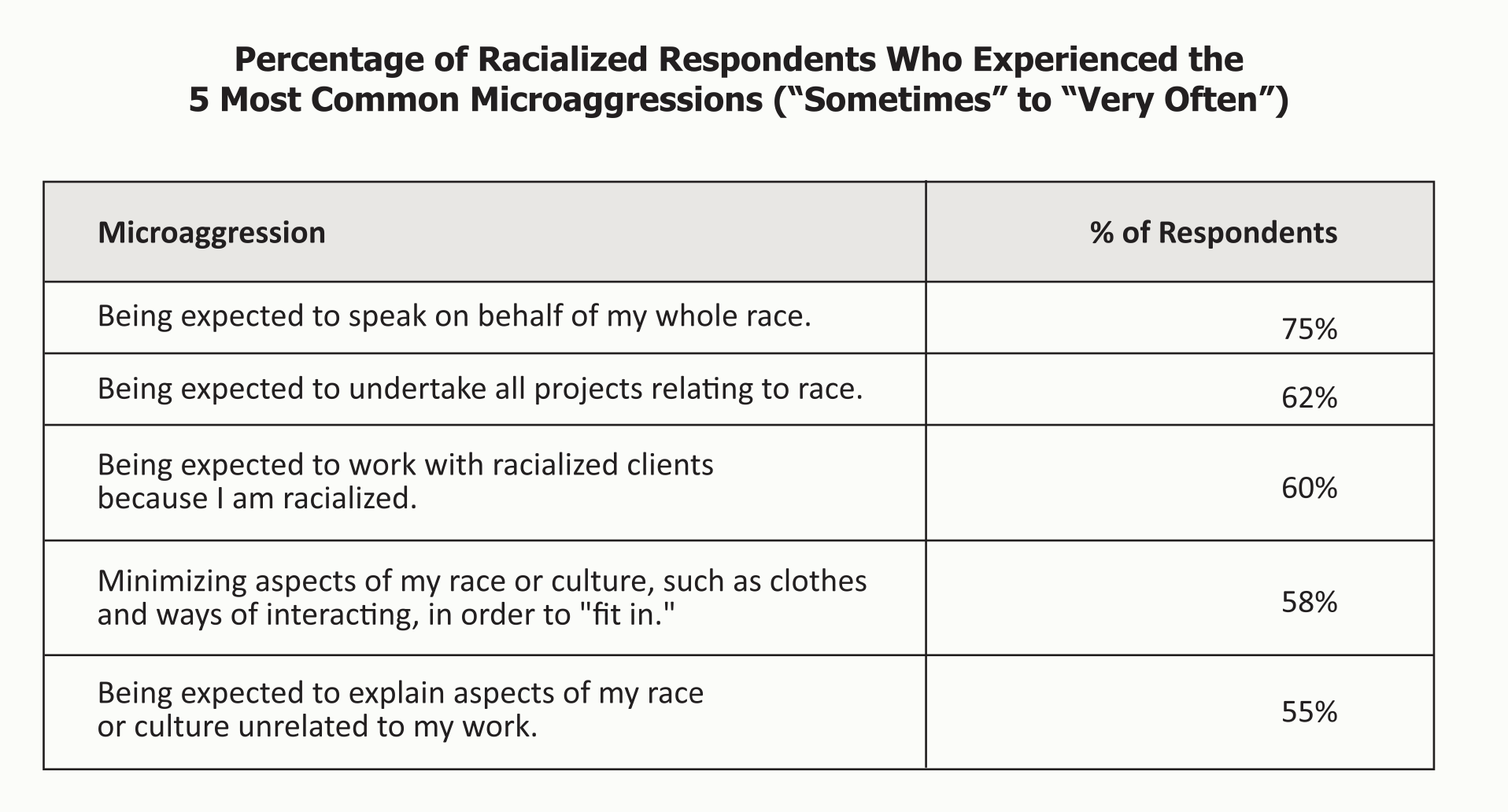
- Racialized women in the community sector suffer racial microaggressions disproportionately to racialized men.This pushes them to leave the sector, and this phenomenon has increased over the last three (3) years.
- Racialized women – especially black women – are both hypervisible and, paradoxically, asked to become invisible. When they occupy positions of leadership, this is often accompanied by an increase in the racism they face, rather than protecting them from it. And although they occupy positions of power, racialized women are still victims of significant discrimination, often more intense.
- Data collected for the report also shows that racialized leaders are under-represented in leadership positions: 10.84% of racialized respondents held leadership positions.
- The majority of racialized managers identified themselves as Black, and 30.46% of white respondents held leadership positions.However, it should be noted that these data represent retention rates over the three years preceding the year of data collection, which was several years ago.
Moving Forward
This event was an opportunity to share COCo’s learnings from the project and the writing of the report. In person, participants had the opportunity to ask the authors questions, explore how to discuss the report with their team and to network. It was a great space for capturing data, validating and amplifying the experiences of racism of the racialized people in the room. COCo received positive feedback and interesting contributions for the future.
COCo is currently working to raise the necessary funds to publish the full results of this research.
We are also considering how best to continue the courageous discussions on the impacts of racism within the non-profit sector in Quebec.These are not conversations that can be launched lightly; they require time and preparation to ensure the safety of all, but especially of those most affected by the topic.
The Diversité d’Abord research report presentation event was a great success!
COCo would like to thank everyone who attended the Diversité d’Abord research report presentation for their interest, their contributions, and especially for their support in promoting the research findings.
COCo encourages the nonprofit groups to use the research report in their workplaces to open a dialogue on racism in our sector.
If you would like to share your reactions and thoughts on the research report, COCo invites you to do so via this research report survey or via info@coco-net.org. If you weren’t able to attend the event, you can watch the video of the event available on our COCo Facebook page here or on our Youtube channel here.

For more information on Diversité d’Abord research, please contact us at info@coco-net.org. We publish our research piece by piece. Take a look at our first two chapters:
- Chapter 1. Understanding the Infographic: The Problem Woman of Colour in Nonprofits
- Chapter 2. Racialized Women in Quebec Nonprofits
To find out more about this project and download the full report, visit our website:
https://coco-net.org/diversite-dabord
Article : Stéphanie Darbouze Lamarre and Janie Janvier
Photo credits : Emmanuella Photos
Research report credits: Lead researcher, Emily Yee Clare.
The report was co-authored by Emily Yee Clare and Kira Page.
Senior data scientist: Alexandra Heggie.

